
STORIES

In the Waiting: Two CanIL Grads and Kwak'wala Bible Translation
Two CanIL grads spent years in what felt like an in-between season. Now those years are shaping their work on a community-led Kwak'wala Bible translation.
Two CanIL grads spent years in what felt like an in-between season. Now it's shaping their work on a community-led Kwak'wala Bible translation.
A newborn does little more than eat, sleep, and demand to be held. Underneath all that repetition, though, something is happening every day. You just can't see it yet.
Chuck and Jocelyn Murphey are learning to look at their own lives the same way.
The Years That Felt Like Waiting
Jocelyn finished her MA in Linguistics in 2019. Chuck followed two years later. Both hoped to serve in Bible translation, but neither knew where. At the time, there were no opportunities for them to support an Indigenous Bible translation project in British Columbia. They could not have predicted that one would eventually emerge, or how closely their work in the intervening years would prepare them for it.
For a while, life was mostly paperwork and patience: the slow process of obtaining permanent residency and joining Wycliffe Canada. In the meantime, they got to work. Chuck and Jocelyn both spent those years supporting Haisla language revitalization efforts in northern British Columbia, part of the Wakashan language family. Jocelyn also worked with Michif, her own heritage language as a Métis woman.
It may have felt like a detour. It wasn't. It would take them years to understand why.
"The Lord has an amazing way of taking our life experience and creating fruit from it in ministry in ways that we could not have foreseen."
Jocelyn Murphey
When the Door Opened
In 2025, that fruit started to show.
Brody Naknakim, a community member who serves with North American Indigenous Ministries (NAIM), invited the Canadian Bible Society, Wycliffe Canada and CanIL to join NAIM in a fresh Kwak'wala Bible translation effort. Under Brody's leadership and coordination, these organizations are working collaboratively with members of several Kwakwaka'wakw communities on Vancouver Island.
Chuck and Jocelyn joined the initiative through Wycliffe Canada and CanIL, bringing their linguistic training and previous experience in Indigenous language revitalization to the wider team.
Kwak'wala, like Haisla, belongs to the Wakashan language family. The years Chuck and Jocelyn had spent listening to and learning from Haisla speakers were, without their knowing it, preparing them to work with another related language. What had once seemed like an in-between season was becoming part of the work they had hoped to do all along.
More Than a Text
For Chuck and Jocelyn, the work has never been only about producing a translated text. Each time the team works through a passage of Scripture together, whether in person or online, everyone involved is engaging with that part of God's Word. Elders, adults, and youth gather through the process, engaging with Scripture and with each other. It's discipleship as much as it is translation: community forming around the Word before the Word itself is even finished.
For Jocelyn, who has spent years working to strengthen her own heritage language, that connection between language and identity isn't theoretical. It's something she's lived alongside, in a different community, in a different season.
The Slow, Unseen Work
Most of that work is small, slow, and invisible from the outside. Chuck participates in online translation sessions, listening to Kwak'wala speakers offering words and phrases. Drawing on what he learned through Haisla, he asks focused questions about spelling and meaning. He then spends hours organizing what's been shared into a growing database, a resource that may one day help support a community-built dictionary.
Equally important to the task of translation is the work of writing Kwak'wala using community-established alphabets.

People driving past First Nations language signage across British Columbia may assume that Indigenous languages share one alphabet. They do not. Languages and communities have different writing systems, each with its own story of how it came to be.
How words are spelled and represented in print is more than a technical decision. It is an important expression of cultural value, history and identity. Learning to work within those established writing systems requires care, humility and attention. There are no shortcuts borrowed from somewhere else.
Why "Making a Bible Translation" Isn't the Whole Story
"Building relationships, developing a deep understanding of the language, and organizing language data don't produce immediate ministry success stories or polished resources," Chuck and Jocelyn explain. "Instead, we are gradually learning how to serve and support the community well."
This can make the work difficult to explain. Saying they are "making a Bible translation" can sound as though the goal is simply a finished object that will one day be handed to a community.
The real answer is bigger than that.
"We want people to encounter the Gospel through Scripture in their own language."
Chuck and Jocelyn Murphey
A finished translation is an important destination, but the process of reaching it creates opportunities for people to encounter Scripture now. Passage by passage and conversation by conversation, translation brings people together around God's Word. The translated passages provide the means for that engagement to continue and spread.
Gathering Around the Word
Brody sees the value of this work firsthand.
"I am happy that Chuck and Jocelyn are part of the team because of their high level of linguistic skills and experience. Also they exemplify what we value in our native culture which is working together and putting family as a high priority."
Brody Naknakim
The significance of this collaborative approach became increasingly visible during the team's visits to northern Vancouver Island in May and November 2025. Across those gatherings, people from different generations participated in the work. It was exactly the kind of gathering the Elders had asked for: to have their faith and language handed down together. Everyone involved was given opportunities to engage with the language, with Scripture and with one another.
For Chuck and Jocelyn, it offered a glimpse of what this careful work can make possible. In a season where progress is hard to measure, the response of community members affirmed that the work matters.
Back at CanIL, and Back to Basics
Back at CanIL, Chuck teaches and supports students preparing for cross-cultural language work. Jocelyn will return to her role as Executive Assistant to the President following maternity leave. Their own next generation arrived in June with the birth of their daughter, Anna.
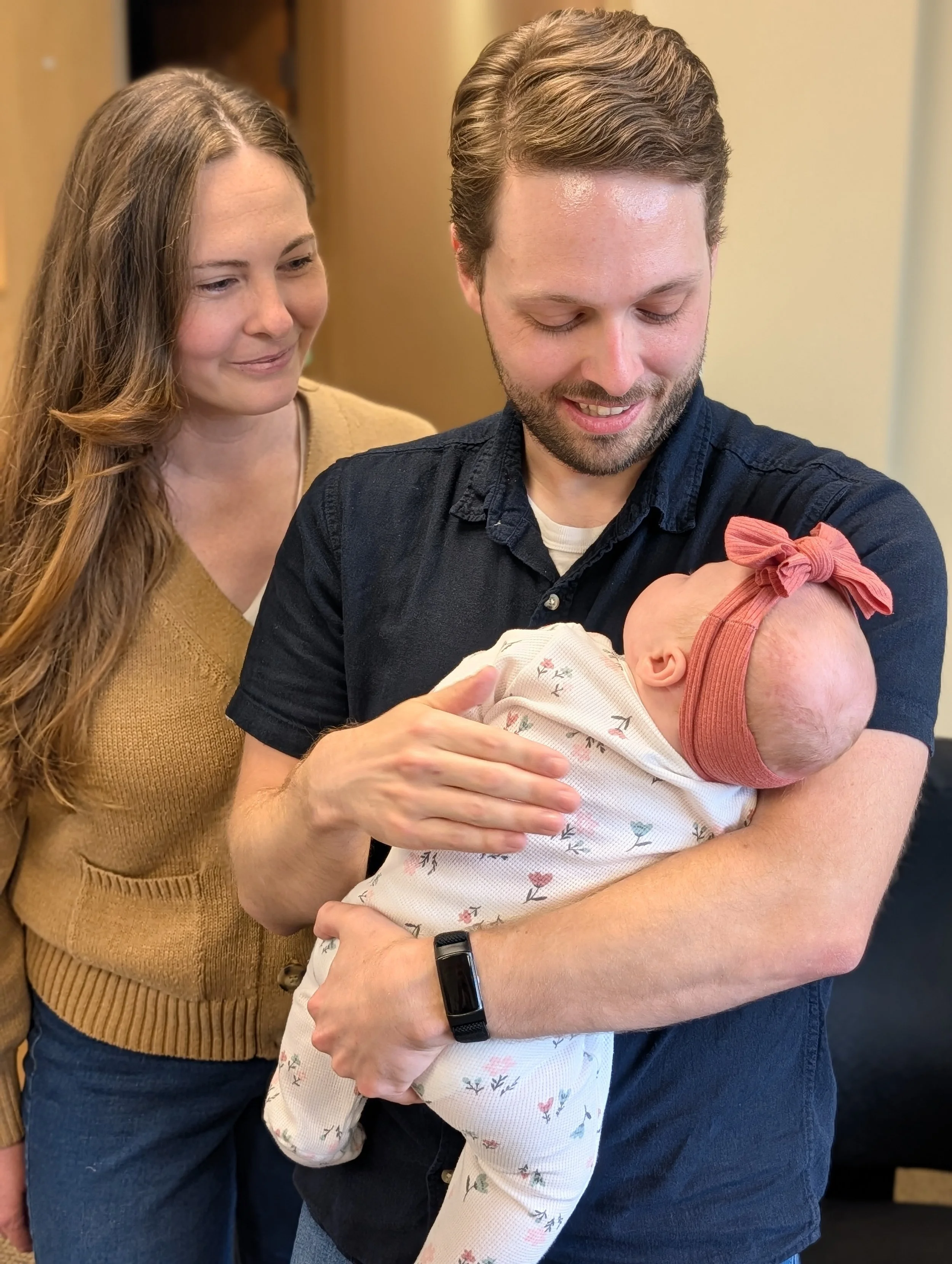
Caring for her has changed how they think about growth that does not always show up on the outside. A baby does not announce her own development. She simply eats, sleeps and grows, whether or not anyone is watching closely enough to notice.
Not Yet, But Already
There is no finished translation to hold yet. But people are already gathering around Scripture. Relationships are deepening. Language is being honoured. The work has begun, and so has the impact.
"For we are God's handiwork, created in Christ Jesus to do good works, which God prepared in advance for us to do." — Ephesians 2:10
Ready to prepare for work like this? Explore CanIL's programs and see how our training equips students to serve alongside language communities.

The Language That Had Never Been Written Down
For centuries, this community's language was never written down. Meet the linguists helping them read it, write it, and now read Scripture in it for the first time.
The location and identifying details in this story have been limited to protect the community and those working alongside them.
Imagine growing up in a place where the language of your heart, the one you speak with your family every day, is never written down. A place where your stories, your history, and your prayers live only in the words you speak. That was the reality for a small indigenous community in Southeast Asia. For centuries, their language was passed down orally, carrying memory, humour, and identity, but never once appearing on a page. With each passing generation, the risk of losing it grew.
Then, a decade ago, a team of linguists, alumni from the Canada Institute of Linguistics (CanIL), arrived.
They came first to listen.
Over the following ten years, they worked closely with members of the community, recording words and stories, studying the rhythms and patterns of a language that had only ever lived in speech. But the linguists didn't do this alone. Fluent speakers held the knowledge that mattered most: which sounds carried meaning, how words were formed, what felt natural on the tongue. Together, piece by piece, they built something the community had never had before. A way to write their own language.
This community is now reading and writing in their own language. It has empowered the people and safeguarded their culture for generations to come.
But the work is not done. The linguists have started translating the Bible into the community's language. It's a slow, careful process that could take several more years to complete. Yet even now, people are beginning to read the Scriptures in their own language for the first time, an experience that is profoundly moving for them.
This story isn't just about language. It's about identity, dignity, and connection. It's about a community reclaiming its voice and passing it down to the next generation.
"Language connects people to their roots, their faith, and each other."
At CanIL, we're privileged to help prepare people for this kind of work. This story is just one of many, but it reminds us of the incredible power of language: to preserve, to heal, to unite.

God Speaks Their Language
Kylie and Matthew Wicker grew up as missionary kids. Now they're back in West Africa, using their CanIL training to help language communities hear Scripture in their own heart language.
Kylie and Matthew Wicker didn't grow up waiting for a single dramatic calling. They grew up as missionary kids, watching their parents live out faith on the ground in West Africa, and somewhere in that childhood, missions simply became part of who they were. What they didn't expect was that their particular gifts, an ear for language, a love for grammar and sound and structure, would become the way they'd serve.
"Language is key to identity," they say. "We want people to know that their identity and culture have dignity and worth so much so that God speaks their language."
Their paths to CanIL looked nothing alike. Kylie first heard about the school through a partnership with Moody Bible Institute's Spokane campus, where summer linguistics courses could transfer toward her degree. The location, the financial aid, and the encouragement of mentors like Dr. David Beine and Anita Lebold made it feel like the right fit. Matthew found his way in through Wycliffe Canada's Race to 2025, drawn by the chance to get world-class training close to home, and shaped by conversations with people who'd walked the path before him.
They came to CanIL for different reasons, but they left with the same conviction: this was where their training would take shape.
"We felt well-equipped for this work through our time at CanIL."
Faculty like Dr. Steve Nicolle and Dr. Sean Allison helped sharpen that preparation. Kylie completed her MA in Applied Linguistics in 2018, Matthew followed with his MA in Linguistics and Translation in 2019, and by the time they finished, they weren't just trained; they were ready.
Today, the Wickers serve with SIL Cameroon in Yaoundé. Matthew works alongside the Sso language community on linguistic analysis. Kylie supports the Iton translation team and helps train national translators and linguists from other francophone countries through programs like i-DELTA. It's work that multiplies itself, not just translating Scripture into one language, but equipping others to carry that work forward into languages CanIL alumni may never personally touch.
For Kylie, the return to West Africa carries a weight that's hard to put into words. She grew up in Togo and Benin, and her family once spent a few months in Cameroon when she was only three months old.
"Thirty-one years later to the day, I arrived back with my own family, a full-circle moment."
For Kylie and Matthew, this work has never just been an academic discipline. It's something closer to restoration. It strengthens communities. It restores dignity. And it opens a door so that, in the language people actually think and dream and pray in, God's Word can finally be heard.

Jesus Speaks Quechua
On a mountainside in Peru, a community held the complete Bible in their own language for the first time. This is what it looked like to witness it.
By Shannon Mischuk, VP of Development, Canada Institute of Linguistics (CanIL)
We left Abancay before sunrise, piled into a van at 4 a.m., and drove for hours through hairpin switchbacks carved into the Andes. The final stretch was a single-lane dirt road hugging the mountainside, the kind of road that tests your faith and your stomach in equal measure.
I was travelling with my boss, Dr. Danny Foster, representing the Canada Institute of Linguistics (CanIL), alongside partners from Wycliffe Canada and AIDIA (Asociación Interdenominacional para el Desarrollo Integral de Apurímac), church leaders from British Columbia, and pastors from across the Apurímac region. We were headed to Colpa, Peru, for a moment more than twenty years in the making: the dedication of the complete Eastern Apurímac Quechua Bible.
Quechua is spoken by millions across the Andes, but the Eastern Apurímac dialect belongs to one specific mountain region of southern Peru, and its people had never held the entire Bible, Genesis to Revelation, in the language that speaks to their heart.
A valley already awake
When we arrived, the valley was alive with colour and anticipation. By mid-morning, the church could no longer hold the crowd. People carried benches outside and arranged them under a sun tarp, and voices in Quechua, Spanish, and English rose together. Some had walked for hours, from villages across the mountaintops, just to be part of this.
Children stood at the front of the service, reading from their new Bibles, their voices steady and sure. I tried to stay unnoticed, wanting to capture the moment without disturbing it. Then another prayer rose, and hands reached for mine from both sides. I wasn't an observer anymore. I was part of it.
As Scripture was read aloud, one phrase moved through the valley:
"Jesus speaks Quechua."
Three words carrying the whole weight of the day. This wasn't just a project reaching completion. It was a promise fulfilled: God speaks every language, and every community deserves to hear Him clearly, in the words they think and dream and pray in.
Two decades of faithfulness
The translation was led by Quechua translators through AIDIA, supported by Wycliffe Canada, and strengthened along the way by Canadian churches, including Christian Life Assembly in Langley, whose support arrived at a critical stage and carried the project forward when progress had slowed. AIDIA's work hasn't stopped since. Their ministry has grown to nine regions across Peru, some so remote that reaching them takes several days of travel, training pastors, strengthening literacy, and helping families bring Scripture into daily life.
Why the classroom matters half a world away
At CanIL, our work is to prepare the students and translation consultants who make projects like this possible, training them to work with the accuracy, clarity, and cultural understanding that Bible translation demands. Without that training, projects stall, and communities wait decades longer than they should to hear Scripture in their own language.
Standing in that valley, watching people read from Bibles that had taken twenty years to complete, I felt the distance between a classroom in Langley and a mountainside in Peru collapse entirely. The people of Colpa didn't just receive a book. They received confirmation that their language, their stories, and their lives matter to God.
Jesus speaks Quechua now. That sentence exists because people gave their lives, their training, and their support to make it true.

Forty Years, One Purpose
"Not upstream. Source." For 40 years, CanIL has trained the linguists behind stories like these. Here's where it started, and where it's headed next.
What language do you dream in?
Take a moment with that question. Think of the language that carries your innermost feelings, the one that speaks directly to your soul, the one your family used around the kitchen table. Now consider this: of the world's 7,394 known living languages, only 756 have a complete Bible. Nearly 1,300 language groups, representing 99.8 million people, still have no Scripture at all in their heart language. Nearly 40% of the world's languages are considered endangered, and on average, one disappears every two weeks, taking with it memory, history, and knowledge that will never be recovered.
That gap is the reason CanIL exists. It's the same gap behind every story we've told so far.
It's the reason a small community learned to write down a language that had never appeared on a page. It's why Kylie and Matthew Wicker are in Cameroon right now, one working alongside the Sso language community, the other supporting Bible translation for the Iton people. It's why a valley in Colpa, Peru gathered under a sun tarp last fall to hold the complete Quechua Bible for the first time in twenty years. Different people, different languages, different corners of the world, one same purpose running underneath all of it.
Not upstream. Source.
At CanIL's 40th anniversary celebration, Dr. Johnstone Ndunde, Executive Director of SIL Global, described CanIL's role in this work more clearly than we ever have ourselves. Strong translation depends on a strong source, and for forty years, CanIL has been exactly that. Long before any linguist sits with elders in a remote village, they sat in a classroom here first, learning to listen well, to live respectfully inside a community, and to do work that may take a decade before anyone sees the fruit.
"God's gift to the world," Ndunde called it. Not because CanIL's graduates are exceptional linguists alone, but because of what they carry into the field with them. "The work we do not only prepares people for the eternal kingdom," he said. "It helps them live well in the world they are in today."
When words change lives
A few years ago, one of our Master of Arts in Translation of Scriptures students was working on a Bible translation project in a remote village in West Africa. Local volunteers had stepped forward to help check the translation for accuracy, a critical, often unglamorous part of the work. But somewhere in that technical review, something shifted. The words on the page stopped being a checklist and started being alive. Community members began gathering just to hear more.
There was no sermon, no strategy, no plan to build a church. Just Scripture, in the language people actually dream in, doing what it does. The village asked our student to help them start their first church.
Where it started
CanIL began small, a summer program at Trinity Western University in 1985, back when it was still called the Canada Summer Institute of Linguistics. It was a department of Wycliffe Bible Translators, and it existed for a single season each year. By the early 1990s, Fall and Spring semesters had been added, turning a summer program into a full year of pre-field training, and the name changed to match what it had become: the Canada Institute of Linguistics.
The growth didn't stop there. By the late 1990s, enrolment had grown enough that CanIL became TWU's newly formed Linguistics Department, offering a BA in Linguistics and a TESL certificate, with a Master's in Applied Linguistics and Exegesis offered alongside it through ACTS Seminaries. At the time, the entire operation- offices, classrooms, library, computer lab- ran out of a 3,000-square-foot portable building.
In 2000, CanIL incorporated separately from Wycliffe Bible Translators, and in 2003, the CanIL Harvest Centre was built on the TWU campus, a three-storey, 32,000-square-foot home with real classrooms, real computer labs, and space for a program that had long since outgrown a portable building.
What forty years actually looks like
Since 1985, CanIL alumni have gone on to serve language communities in more than 40 countries, doing linguistic research, literacy development, orthography development, language survey, Bible translation, and teaching - work that rarely makes headlines but reshapes the communities it touches. Along the way, CanIL has held onto a founding conviction that a person's ability to serve shouldn't be limited by their finances, offering bursaries, scholarships, and paid work experience so students can pursue this calling without the burden of debt following them into the field.
Revelation 7:9 describes a vision of "every nation, tribe, people and language" gathered together. It's not just poetry. It's the picture CanIL has spent forty years working toward: one language, one community, one translated verse at a time.
We don't know yet whose story we'll be telling ten years from now, which language will finally get its first written word, which village will gather to hear Scripture for the first time. But we know it's coming. For forty years, that's what this place has been built to do. It's the source.